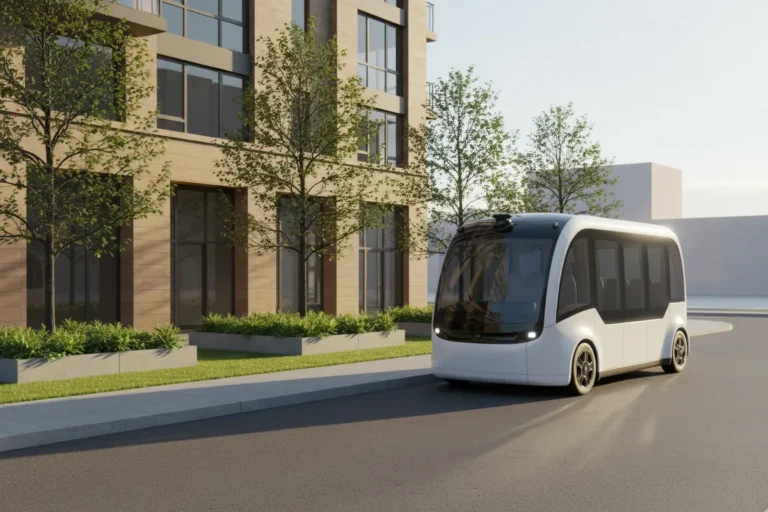
Autonomous vehicles are poised to reshape real estate markets in ways most investors haven’t fully considered. This article examines eight strategic opportunities emerging from self-driving technology, from repurposing parking structures to capitalizing on expanded commute zones. Industry experts weigh in on actionable predictions that could redefine property values and development priorities across urban and suburban markets.
- Target Outer Ring Growth as Travel Eases
- Bet on Detroit Connectivity Corridors
- Convert Garages to Resident Amenities
- Favor Secondary Distribution and Expand Commute Radius
- Shift Logistics to Exurban Hubs
- Prioritize Compliant Curb Access Design
- Repurpose Office Lots for Suburban Flex
- Redevelop Obsolete Vehicle Storage into Density
Target Outer Ring Growth as Travel Eases
Autonomous vehicles will gradually reshape where people are willing to live and what they’re willing to pay for. The biggest impact will be on the commute calculus that drives so much of residential real estate pricing.
Right now, a 45-minute commute in stop-and-go traffic is a dealbreaker for many buyers. But if that same commute happens in a self-driving vehicle where you can work, sleep, or decompress, it stops being wasted time. It becomes usable time. That single shift changes the math on suburban and exurban property values significantly.
Here’s a specific example from my market: In Tampa Bay, communities like Zephyrhills, Dade City, and eastern Pasco County sit 40 to 60 minutes from downtown Tampa. Today, prices there are substantially lower than closer-in suburbs like Brandon or Riverview largely because of the commute penalty. Once autonomous vehicles remove the friction of that drive, those areas become far more attractive to buyers who want more land, newer construction, and lower price points without sacrificing access to metro employment centers. You’d see demand and values rise in those outer-ring communities while some of the premium currently baked into close-in suburbs could soften.
The development side shifts too. Garages and parking minimums have driven residential design for decades. As personal vehicle ownership declines and autonomous rideshare grows, builders can reclaim that square footage for living space or reduce construction costs entirely. Subdivisions won’t need the same parking infrastructure, which changes lot density, site planning, and per-unit economics.
The timeline is longer than the hype suggests. We’re years away from widespread adoption. But for investors and developers making 10 to 20 year bets, autonomous vehicles will reward those buying in well-positioned outer-ring markets before the pricing shift catches up.

Bet on Detroit Connectivity Corridors
Running furnished rentals in Detroit while coming from a logistics and transportation background—including years operating freight and a limousine fleet—gives me a grounded read on how mobility shifts ripple into real estate.
The specific impact I’d watch in Detroit: autonomous vehicles will likely accelerate development along corridors that are currently underserved by transit. Detroit is already navigating this with options like the Q-Line and MoGo Bike Share, but AV adoption could unlock neighborhoods that guests and renters currently overlook simply because getting around without a car feels uncertain.
For my rentals, guest location decisions are heavily tied to “can I get around easily from here?” If AVs remove that friction, properties in transitional Detroit neighborhoods—currently undervalued—become genuinely competitive overnight. That’s where I’d be looking to acquire now, before that shift prices in.
The real estate opportunity isn’t just in popular downtown blocks. It’s in betting on connectivity before the market does.

Convert Garages to Resident Amenities
As Marketing Manager at FLATS and Funnel Forum’s 2024 Visionary of the Year, I evaluate urban demographics and location trends to position luxury portfolios in markets like Chicago and San Diego. I focus on how strategic assessments and cutting-edge technology influence the long-term competitiveness of new developments.
AVs will likely lead to the “de-parking” of urban real estate, allowing developers to convert underutilized garage space into high-value resident amenities. At The Rosie, prioritizing social spaces like a rooftop pool or pet-friendly facilities over massive parking footprints reflects this shift toward lifestyle-centric urban living.
This transition will increase the value of properties that integrate flexible living tech, such as the ORI semi-furnished units we offer to healthcare professionals in Chicago. As AV fleets handle transit, the focus moves to internal unit innovation and high-design permanent signage to capture the attention of passengers who are no longer focused on the road.
By leveraging strategic assessments, we ensure our brand identity systems evolve as traditional car-related infrastructure becomes redundant. Focusing on “lifestyle-as-a-service” will be the primary driver for occupancy and ROI as the physical requirement for resident-owned vehicle storage diminishes in the urban core.

Favor Secondary Distribution and Expand Commute Radius
Managing properties across residential, commercial, HOA, and short-term rentals gives me a front-row seat to how infrastructure shifts actually move tenant and investor behavior before the broader market catches on.
The most underrated AV impact I’d watch is what happens to industrial and commercial real estate near logistics corridors. As autonomous freight becomes viable, demand for last-mile distribution facilities in secondary markets like ours in South Bend will spike. We’re already managing industrial facilities, and I can tell you that tenant interest in well-located warehouse and logistics space is heating up in ways it wasn’t two years ago.
On the residential side, I think the bigger story isn’t parking — it’s commute radius expansion. If a 45-minute drive becomes productive work time inside a vehicle, buyers will stretch farther from city centers. That directly affects how we price and position properties in our portfolio, especially as we’ve expanded our service area twice in the past year chasing exactly that kind of market movement.
For investors, I’d be watching mid-market cities with strong highway access and affordable land. They’re positioned to absorb both the logistics demand and the residential spillover that AVs will likely accelerate.

Shift Logistics to Exurban Hubs
I watched warehouse real estate explode in value during COVID, and autonomous vehicles are going to trigger the same pattern in reverse for suburban strip malls. Here’s what I mean.
When I built my 140,000 square foot fulfillment facility, we chose a location based on three factors: highway access, proximity to our labor pool, and distance to major metro areas for two-day ground shipping. The labor factor was massive. We needed people who could commute reliably. That constraint shaped where every 3PL and warehouse could exist.
Autonomous delivery flips that equation. The specific shift I’m watching: secondary logistics hubs in exurban areas are going to skyrocket in value while traditional warehouse districts closer to cities lose their premium. Why pay urban land prices when your autonomous fleet can run 24/7 from somewhere 40 miles out with half the real estate cost?
I’m already seeing early signs. A client of mine in the outdoor equipment space just signed a lease in a former shopping center two hours outside Denver. The landlord converted the anchor store and parking lot into a micro-fulfillment center because autonomous last-mile delivery makes the distance irrelevant. That same property was nearly worthless three years ago.
The math is simple. If labor doesn’t need to commute and vehicles don’t need drivers, proximity to population centers matters way less for logistics real estate. I’d bet we’ll see a 30 to 40 percent value decline in traditional warehouse parks near major cities within ten years, while those dying suburban retail properties get bought up and converted into automated fulfillment nodes.
The real winners? Towns with cheap land near interstate exchanges. They’re about to become the new logistics goldmines, and most of them don’t even know it yet.

Prioritize Compliant Curb Access Design
I’m a co-founder/investor in Cedar Creek Construction in the Lehigh Valley (decks, patios, renovations, fencing), and I’ve built and exited multiple companies—so I look at real estate through “what changes behavior + what changes build decisions.”
Autonomous vehicles make “drop-off convenience” and curb management more valuable than raw parking count, so properties that can legally and safely handle frequent short stops will win. Think lots with a clear pull-off zone, good sightlines, and layouts that don’t force cars to block sidewalks or back into traffic.
Specific example: in older Lehigh Valley neighborhoods with tight streets, a corner lot or a home with a side-entry driveway can become more desirable because it can support a dedicated pick-up/drop-off pad without triggering a zoning/permit headache. The same way we’ve rebuilt work that failed inspection (like unpermitted decks), the “can I do this compliantly?” factor will increasingly show up in what buyers pay for.
Development trend shift: builders will start designing site plans around permitted, code-compliant curb interfaces—setbacks, turning radii, and pedestrian-safe access—because AV-heavy streets punish sloppy circulation. The “boring” due diligence (permits, inspections, clear scope) becomes a value driver, not paperwork.

Repurpose Office Lots for Suburban Flex
With my SIOR designation and decades as a tenant rep—from 15 years at Grubb & Ellis to leasing flex/tech offices at Highwoods Properties in North Carolina’s Research Triangle—I’m positioned to spot transportation’s ripple effects on office markets.
Autonomous vehicles will cut parking demand in urban offices by 30–50% (per industry benchmarks I’ve tracked), freeing land for expanded leasable space.
One specific example: Property values in Pittsburgh’s northern suburbs like Pine Township could surge as AVs enable flex/tech developments, much like the class-A office boom I advised on around Research Triangle Park.

Redevelop Obsolete Vehicle Storage into Density
Everyone is focused on how self-driving cars will change our commutes. But they’re missing the bigger picture. Autonomous vehicles are going to absolutely gut the commercial parking industry. Think about it. Why pay a premium to park downtown when your car can just drop you at the office and drive itself to a cheap lot ten miles away? Or just circle. The immediate impact isn’t on the road. It’s on the pavement we use to store empty metal boxes.
Look at mid-rise parking garages in urban cores. Those concrete monstrosities are sitting on gold mines. Once AV adoption hits a tipping point, the utility value of a dedicated parking structure plummets to zero. But the land value? It skyrockets. We are going to see a massive wave of adaptive reuse. Developers will snap up these obsolete garages and gut them to build high-density housing or last-mile fulfillment centers. It’s inevitable.
Suburbs will feel it too. Homes won’t need two-car garages anymore. Builders are already quietly testing floor plans that swap the massive attached garage for an accessory dwelling unit or a dedicated home office. We track auto asset risk constantly at Insurance Panda. And the logic points to one thing. The moment a car doesn’t have to sleep where its owner sleeps, the entire map of real estate value flips upside down.