

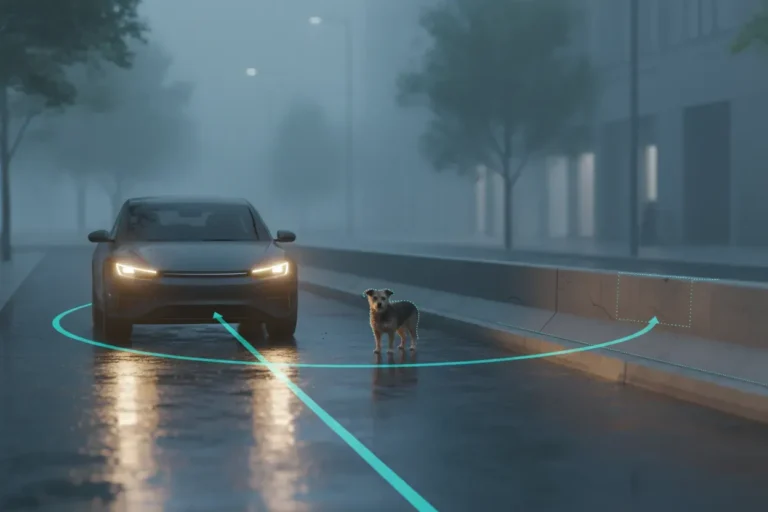
Autonomous vehicles promise safer roads, but they raise profound ethical questions about who lives and who dies when accidents become unavoidable. This article examines ten critical dilemmas that engineers, policymakers, and society must address before self-driving cars become commonplace, drawing on perspectives from ethicists, technologists, and legal experts. From algorithmic bias in split-second decisions to corporate accountability for system failures, these challenges demand urgent attention and transparent solutions.
- Hold System Owners Criminally Responsible
- Safeguard Unseen Street Users First
- Reject Metrics Over Individual Protection
- Demand Lifelong Car Performance Records
- Coordinate Failures With Roadside Responders
- Publish Crash Value Hierarchy Transparently
- Prove Safety Choices and Enforce Accountability
- Detect and Halt Operational Drift Early
- Prevent Deceptive Passenger Crisis Messages
- Expose Bias in Unavoidable Harm Decisions
Hold System Owners Criminally Responsible
The dilemma that bothers me is not the trolley problem. It is accountability engineering: structuring a deployment so that when someone dies, the only person facing a judge is the one who had the least authority over how the system behaved.
Tempe, March 2018: An Uber test vehicle killed Elaine Herzberg. Uber had switched off the Volvo’s factory automatic emergency braking so it would not fight the self-driving software, cut the safety crew from two seats to one, and left the remaining operator, Rafaela Vasquez, with no say over the software, the route, or the staffing. The NTSB named her inattention as the probable cause and listed Uber’s inadequate safety culture among the contributing factors. Vasquez pleaded guilty to endangerment and drew three years of supervised probation. Prosecutors declined to charge Uber at all.
Five years later, same shape, nobody in the seat. In October 2023, a Cruise robotaxi in San Francisco struck a pedestrian who had been thrown into its path by a hit-and-run driver, then attempted a pullover maneuver and dragged her about 20 feet, because nothing in the sensor suite understood that a woman was pinned underneath. Then the part that should worry people: Cruise did not show California regulators the dragging footage. Once it came out, the state pulled the permit, the CEO resigned, nine executives were dismissed, and NHTSA settled for a $1.5 million penalty. Real consequences. None of them judicial. Vasquez stood in front of a judge.
I spent 17 years at the FAA, part of it teaching at the FAA Academy, and aviation paid for this lesson in bodies. Investigators stopped stopping at the last hand on the controls decades ago. They go after the training program, the maintenance decision, the schedule pressure, and the manager who approved the workaround. Surface transportation has not made that turn yet. “Human in the loop” gets treated as a compliance checkbox instead of a control with real authority behind it, and while liability keeps terminating at the last human touchpoint, the incentive is to spend less on safety and keep a low-wage employee in the seat as a legal buffer.
That is the scenario I keep coming back to. Not a machine deciding who to hit. A company deciding in advance who takes the fall.
Safeguard Unseen Street Users First
The hardest ethical question for autonomous vehicles is not whether they make fewer mistakes overall, but whether they normalize sacrificing the person least visible to the system. Picture a child stepping off a curb between parked vans while an autonomous shuttle approaches at a lawful speed. The sensors identify uncertainty, but only after the stopping window has narrowed.
I find that troubling because the danger falls on whoever is hardest to detect, not necessarily whoever acted least carefully. In practice, that can shift risk onto children, wheelchair users, or shorter pedestrians. A transportation future that quietly penalizes imperfect visibility would reward technical convenience while leaving the most vulnerable road users to absorb the cost.

Reject Metrics Over Individual Protection
The ethical dilemma that troubles me most is assigning moral authority to a system that can be optimized around fleet metrics rather than individual safety. Autonomous vehicles will be judged by average performance, but real harm happens in outlier moments. That gap matters. Security has shown repeatedly that organizations can meet targets, pass audits, and still miss the exact scenario that damages trust. Ethics becomes dangerous when measurement starts standing in for judgment.
Think about a delivery vehicle entering a dense downtown crosswalk zone during peak hours. To maintain route efficiency, the system is tuned to make assertive but legal merges through pedestrian heavy traffic. Nothing appears broken, and I see the risk in that. A design can satisfy policy while conditioning vulnerable road users to absorb the uncertainty. Ethical transportation should protect the least informed person in the scene, not just the average system score.

Demand Lifelong Car Performance Records
However, the issue that keeps me up at night is not the “who should the car hit” dilemma, but rather that of accountability for all these cars after the initial purchase period has come and gone. Autonomous and semi-autonomous vehicles collect a massive amount of data about how they drive—when did the car step in and what happened when it did? Did it make any mistakes? Were there any accidents when it was running in autonomous mode? Virtually all of this information currently leaves the car when the first owner sells it off.
Consider a previously owned SUV with an advanced driving assist system that has been in a minor accident while running on that very system. The bumper and a forward-facing camera were replaced, and the title remains clean. Two years down the line, some family purchases it, not knowing that the automation has miscalculated the situation—or, even worse, that one of its sensors has been replaced in a shop that failed to recalibrate it properly. This family will be relying on a system which real-world performance is completely unknown to them. Thus, the problem of ethics does not only lie in how the car reacts in a specific situation, but also whether the second owner knows about this reaction at all.

Coordinate Failures With Roadside Responders
As the owner of a towing and recovery company, my biggest concern is how autonomous vehicles make decisions when something goes wrong unexpectedly. For example, if an autonomous vehicle breaks down in a live traffic lane, does it prioritise passenger safety, surrounding traffic, or clearing the road as quickly as possible? A delayed or incorrect decision could put motorists, emergency responders and recovery operators at risk. Until autonomous systems can consistently communicate their status and intentions with roadside services, there will always be scenarios where human judgement remains essential.

Publish Crash Value Hierarchy Transparently
The ethical dilemma that concerns me most with autonomous vehicles is how we program unavoidable crash choices into the software. Picture this: a self-driving car hits black ice on a two-lane road. Straight ahead is a motorcyclist. Swerving left hits a minivan with a family of four. The code has milliseconds to pick. Who lives? That decision sits with remote engineers and corporate risk teams, not the people riding inside or walking nearby. I don’t trust black-box algorithms to carry that weight without full transparency.
At A-S Medication Solutions we deal with automation every day through point-of-care dispensing and prepackaged medications that reduce human error across more than 3,600 provider sites. We’re licensed in all 50 states and registered with the FDA and DEA, so we know what it means when technology makes high-stakes calls. When we roll out automated systems for clinics or mail-order programs, we explain the tradeoffs straight to clinicians and health institutions. Speed versus double verification. Convenience versus the extra step that catches a mismatch. We prioritize patient safety first when resources or reaction windows get tight, and we build trust by spelling out exactly how the system decides.
I research any public stance the same way we prepare guidance for our partners: study real outcomes, listen to the people who live with the results, then communicate the limits clearly. For AVs I’d demand the same standard. Publish the decision hierarchy. Let riders and cities see the values baked in. Don’t hide the hard choices behind marketing slogans. We’ve run that playbook since 1968 with integrated pharmacy solutions that put adherence and safety ahead of shortcuts, and the principle travels. Accountable design beats silent code every time.

Prove Safety Choices and Enforce Accountability
The ethical dilemma is letting a vehicle take over safety decisions that should be made by a human driver. As a trial attorney, I regularly analyze whether the driver acted reasonably just before a crash. In the case of autonomous cars, much of that decision-making is determined in advance by those who design and program the system. When all of the choices will result in someone getting seriously injured, who gets to decide what the vehicle should do?
Think of the situation where an autonomous vehicle comes close to a construction zone, the workers are beside the road and lane markings are hard to identify. If the autonomous vehicle neither stops nor safely avoids the workers, then it’s more than a software mistake. My fear is whether this situation was even taken into account and tested for before putting the vehicle on public streets.
Note that public confidence will only follow from the assurance that the safety decisions were tested thoroughly and made with real accountability when things go wrong.
Detect and Halt Operational Drift Early
The ethical dilemma that concerns me most is silent degradation, when autonomous vehicles continue operating safely enough to avoid obvious failure while slowly drifting below acceptable judgment quality because environments change faster than update cycles. In scaled systems, this is dangerous because performance decay rarely announces itself dramatically at first.
Imagine an autonomous vehicle trained in a city before a major redesign of bike lanes, curbside loading patterns, and delivery traffic behavior. Months later, it still functions, but starts making small incorrect assumptions around cyclists emerging from new protected corridors. I have seen mature operational teams treat gradual variance as noise until incident patterns become undeniable. The ethical issue is allowing public exposure during that gray zone. If monitoring cannot detect meaningful drift early, deployment discipline is not yet strong enough.

Prevent Deceptive Passenger Crisis Messages
The ethical dilemma that concerns me most is emotional manipulation during crisis. Autonomous vehicles may eventually communicate with passengers in real time, and the wording used in emergencies could shape consent, panic, and even legal exposure. That means ethics is not only in the steering decision, but also in the message delivered while that decision unfolds.
I think about a bridge approach where brake failure in a nearby truck forces the vehicle into an impossible choice. The system says, remain calm, executing safest available action, without revealing that it is redirecting impact toward a barrier on the passenger side. If language is designed to reduce alarm rather than convey meaningful truth, autonomy starts borrowing trust it has not fully earned.
Expose Bias in Unavoidable Harm Decisions
The deepest concern is not machine error alone, but whose safety gets prioritized when harm cannot be avoided. Autonomous systems learn from data, and data often reflects unequal roads, neighborhoods, and enforcement histories. That creates a moral hazard where vulnerable communities bear hidden testing costs. I see the greatest risk in decisions presented as neutral mathematics.
Imagine an older district with faded lane markings, heavy foot traffic, and inconsistent curb design. A vehicle approaching dusk detects uncertainty around a wheelchair user and two crossing teenagers. It brakes late, then swerves toward the curb because passenger protection outweighs external risk. If that logic performs worse in underinvested areas, mobility innovation becomes discrimination at scale.


