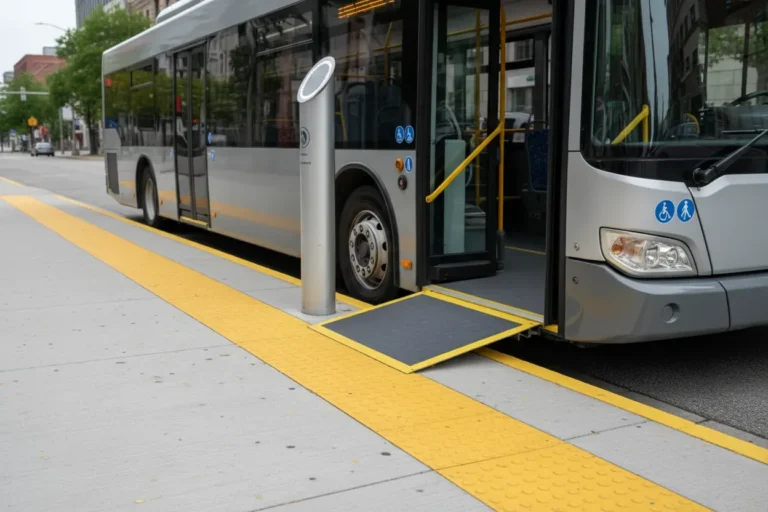
Public transit systems across the country continue to fall short in serving riders with disabilities, despite decades of legal requirements and promises of improvement. This article examines four critical changes that could transform accessibility in transportation, drawing on recommendations from disability advocates and transit specialists. These practical reforms address everything from elevator maintenance to rider feedback systems that actually work.
- Treat Elevator Outages as Service Alerts
- Establish Permanent Rider Advisory Panels
- Prioritize Real-Time Pickup Confirmation
- Tie Purchases to Measurable Disability Results
Treat Elevator Outages as Service Alerts
Fix the information layer first, because it is the cheapest thing on the list and it is failing constantly.
Accessibility data already has a place to live in the standard feeds agencies publish: whether a stop is wheelchair accessible, whether a vehicle is, whether an elevator is out right now. In practice those fields are frequently empty, stale, or never validated. A rider who cannot trust the accessibility field does not get a degraded trip, they get no trip, because they cannot risk arriving at a stop they cannot use.
What makes this worse is that it is invisible to the agency. A rider who checks the app and stays home generates no complaint and no data. The service looks fine because the failure is silent.
I have looked at feed quality across a region and the pattern that surprised me was that the largest, best-resourced agencies still showed gaps. It was not a capability problem. They had the technology. The failures were registration and validation, the unglamorous work of making sure the data is actually published, actually current, and actually correct.
So the specific recommendation: treat an elevator outage as a service alert with the same urgency as a bus detour, and audit your accessibility fields on a schedule. Not new technology. Just treating that data as service critical, which for some riders it entirely is.

Establish Permanent Rider Advisory Panels
At Sunny Glen Children’s Home we’ve learned that real accommodation starts with listening before you build. Transit agencies should put people with disabilities on every design and review board from day one, not as an afterthought. That’s my specific recommendation: create permanent rider advisory panels made up of folks who actually use mobility aids, screen readers, and paratransit every day, and give them real say on route changes and vehicle purchases.
We’ve served more than 25,000 children since 1936 in San Benito and the Rio Grande Valley, many arriving from crisis with physical and emotional needs that force us to prioritize access every single day. When resources get tight we don’t cut the supports that let kids feel included. We explain tradeoffs clearly to stakeholders so trust stays solid. Transit leaders can do the same. Research what riders need by riding with them, then communicate every change in plain language across multiple formats.
I’m talking about apps that work with voiceover, stop announcements that aren’t muffled, and drivers trained to wait without rushing. Our Supervised Independent Living program for youth 18-21 at the Allen House shows us that independence hinges on systems that don’t leave anyone stranded. If a young person can’t reach a job interview because the bus ramp failed or the schedule wasn’t accessible, the whole community loses. Agencies that treat accessibility as core operations, not a compliance checkbox, will earn loyalty and serve everyone better. Don’t wait for complaints. Invite the experts who live it and act on what they say.

Prioritize Real-Time Pickup Confirmation
Transit agencies can better serve people with disabilities by prioritizing real-time communication tools that confirm rides and share live updates without extra steps. My specific recommendation is to equip every paratransit and fixed-route system with simple voice-enabled apps and large-print kiosks so riders get instant pickup confirmation and status alerts they can actually use.
I’ve seen the power of removing friction firsthand at A-S Medication Solutions. We run point-of-care medication dispensing that lets physicians hand patients their prescriptions right at the appointment. That setup eliminates the separate pharmacy trip, which is huge for anyone managing mobility limits. When budgets tighten we still put barrier removal first because it builds trust faster than any other move.
The same logic applies here. Don’t just add vehicles; make every interaction predictable. We explain tradeoffs to our healthcare partners the same way: spend on clear tools and staff training now so people stop missing care later. Researching real user needs before we launch any clinical program or wholesale solution keeps our services practical, and transit teams can do exactly that by testing apps with disability advocates early.
Clear, reliable info turns a stressful ride into something people count on. Agencies that lock in this one improvement will raise ridership and show they truly respect every passenger.

Tie Purchases to Measurable Disability Results
The most overlooked improvement is requiring every procurement contract to include measurable disability outcomes, not just broad compliance language. New buses, fare machines, trip apps, shelters, and station upgrades are often purchased without clear testing standards tied to daily rider experience. I look at this as a preventable systems problem because access gaps are frequently built into decisions long before the public ever sees the final equipment or layout.
Contracts should require user testing by disabled riders, penalties for failed accessibility benchmarks, and release of performance data so future purchases are shaped by evidence rather than assumptions.