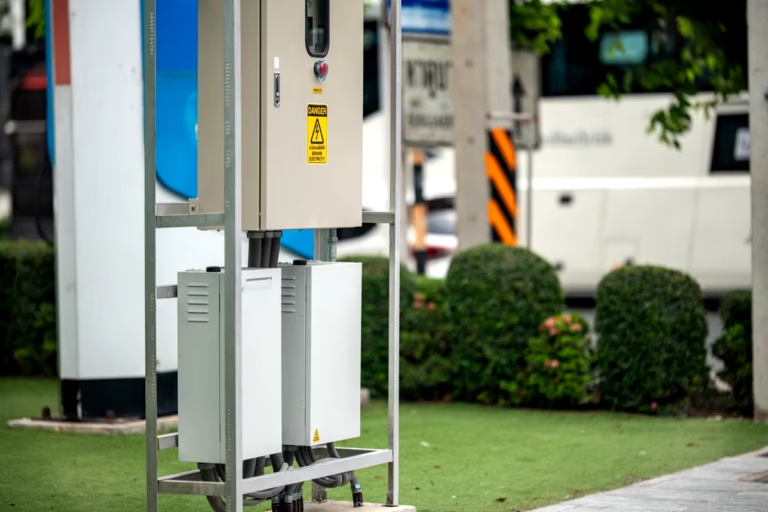
Smart transportation is undergoing a profound transformation, shifting from isolated technologies to integrated, coordinated systems. By 2026, a clear global trend emphasizes the seamless connection of vehicles, roadside infrastructure, and cloud platforms. This evolution aims to optimize urban mobility efficiency in real time, moving beyond simple congestion reduction.
This integrated approach forms a foundational layer for next-generation transport infrastructure. It supports more practical applications of autonomous driving and enhances traffic management with predictive capabilities. Dr. Emily Zhang, an expert in transportation tech, highlights the importance of this shift. She states that the future of city transit relies on smart solutions that boost both efficiency and sustainability according to one report.
Vehicle-Road-Cloud Integration Takes Center Stage
For many years, smart transportation development focused on individual components. These included smart traffic lights, vehicle detection systems, and in-vehicle intelligence. Often, these evolved independently. However, by 2026, these elements are increasingly forming integrated architectures with unified perception and coordinated decision-making. This shift replaces fragmented intelligence with system-level coordination a global trend suggests. This integration allows connected vehicles to communicate with each other. It also enables them to predict traffic patterns, ensuring smoother journeys and reducing accidents.
AI and Digital Twin Traffic Management
Artificial intelligence (AI) is central to this paradigm shift, moving traffic management from reactive control toward predictive and simulation-driven decision-making. With advances in AI models and the growing adoption of digital twin technology, traffic systems can simulate outcomes before actions are taken. This capability enables cities to test signal timing strategies in virtual environments. It also helps evaluate traffic impacts of major events or infrastructure changes. Control strategies can be dynamically optimized based on real-time data. Cities implementing AI solutions have seen traffic reductions up to 30%. This indicates a significant improvement in urban flow. The development of AI research partnerships also supports these advancements.
Autonomous Driving’s Practical Deployment
The global conversation around autonomous driving is also evolving. Instead of asking when full automation will universally arrive, the focus is on practical deployment. Cities and operators are now asking where, how, and under what conditions Level 4 autonomous driving can be safely commercialized by 2026. This includes scaling in defined areas and specific use cases. Examples are campuses, ports, logistics hubs, and industrial zones. Fixed-route autonomous shuttles and feeder services are also being deployed. Designated urban districts with supportive infrastructure are key targets. These deployments prioritize safety, controllability, and replicability. They depend heavily on roadside sensing, signal coordination, and cloud-based traffic management. This reinforces the critical role of smart transportation systems in the autonomous mobility ecosystem. The expansion of autonomous vehicle insurance also reflects this practical approach.
Broader Smart Mobility Innovations
Beyond vehicle-road-cloud integration and targeted autonomous deployments, other smart mobility innovations are gaining momentum. Electric public transport, including buses and trams, is going green, cutting down pollution and making cities cleaner. Drone delivery systems are also emerging. This shift could reshape logistics and minimize carbon footprints. However, infrastructure upgrades are crucial to support these new systems. Not every area is ready for these changes. It is essential to evaluate local readiness for adopting smart solutions. The focus on integrated mobility and smart city futures highlights this need.
The journey toward a comprehensive smart transportation ecosystem requires continuous improvements and collaborative efforts. While technology advances rapidly, challenges like data security and privacy concerns persist. Upgrading infrastructure to support these new systems also remains a significant hurdle. The clear trend for 2026 is robust integration and practical, safe deployment. This will help realize the full potential of efficient and sustainable urban mobility.