

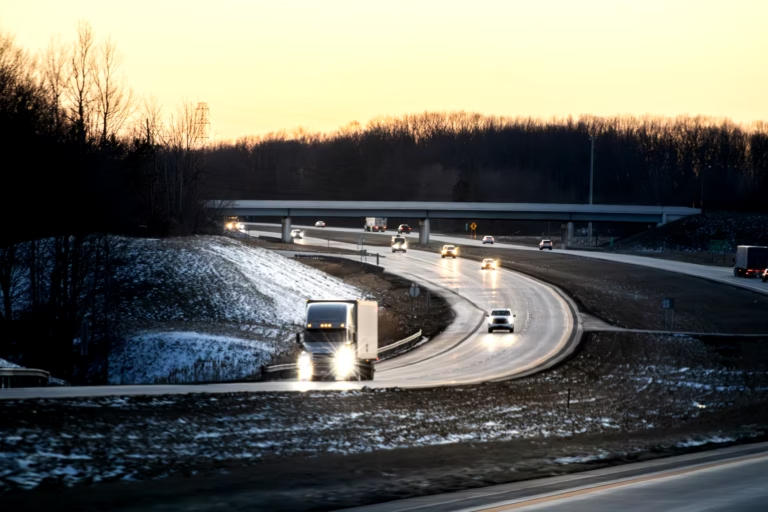
The House Transportation and Infrastructure Committee approved the BUILD America 250 Act in May 2026, marking the first congressional effort to establish a unified federal standard for autonomous commercial vehicles operating across state lines. The bipartisan bill, which passed 62 to 2, would require the U.S. Department of Transportation to develop performance-based safety standards for automated driving system-equipped trucks within two years of enactment and mandate manufacturer certification before deployment. For autonomous freight companies, the legislation addresses what may be the sector’s largest operational barrier: the current patchwork of state-by-state regulations that delay market expansion and complicate fleet planning.
Today, autonomous trucking operators navigate overlapping permitting requirements, regional operational restrictions, and inconsistent safety protocols that make scaling across interstate corridors costly and unpredictable. Kodiak, one of the leading autonomous freight developers, has characterized this fragmented landscape as a significant drag on commercialization speed. A federal framework, industry advocates argue, could reduce compliance complexity, clarify liability and incident response procedures, and create a level playing field for companies planning national deployments. The timing reflects broader congressional recognition that autonomous commercial vehicles represent a competitive advantage for U.S. freight logistics if regulatory barriers don’t stifle growth.
What the Federal Framework Would Address
The BUILD America 250 Act targets several operational and safety domains that currently vary by jurisdiction. Safety certification and vehicle inspection protocols would be standardized nationally, reducing the need for manufacturers and operators to tailor compliance programs for each state. Remote operations and incident response procedures would be defined at the federal level, establishing clear expectations for monitoring, intervention, and data collection. The legislation also specifies requirements for cab-mounted warning beacons, ensuring that autonomous trucks signal their operational mode to other road users. Data reporting standards would create a unified system for tracking performance metrics, safety events, and near-miss incidents across the national autonomous fleet.
These provisions aim to replace the current model in which states like California, Arizona, and Texas set their own testing and deployment conditions independently. While state-level oversight has served as a testing ground for early autonomous projects, companies argue that inconsistency raises costs and limits the ability to move trucks and route optimization algorithms across jurisdictional boundaries without rework. Federal standards would not eliminate state involvement but would establish baseline requirements that companies could count on nationwide.
Industry Support and the Safety Caveat
Aurora and Kodiak, two major autonomous trucking developers, have publicly endorsed the federal framework concept, framing it as a signal that Congress recognizes the economic potential of autonomous freight while understanding the regulatory barriers to scale. Gerardo Interiano, senior vice president at Aurora, called the bill’s inclusion of an autonomous commercial vehicle framework “immense” for fortifying the American economy through freight modernization. Daniel Goff, vice president of external affairs at Kodiak, stated that federal consistency would “significantly accelerate” the company’s ability to deploy and commercialize operations across the United States.
However, industry leaders have emphasized a critical condition: federal consistency must support strong safety oversight, not replace it. The bill’s requirement for NHTSA to establish a performance-based safety standard reflects this balance, placing safety certification at the federal level while leaving room for ongoing operational and cybersecurity requirements. This framing matters because autonomous trucking operates in a public safety context distinct from consumer autonomous vehicles. Trucks are heavier, operate at highway speeds, and share the road with passenger vehicles and pedestrians, raising the bar for what regulators and the public will accept as “safe enough.” Manufacturers have indicated willingness to submit to rigorous testing, data reporting, and third-party audits as long as those requirements are consistent across states.
Unresolved Questions Around Enforcement and Liability
The BUILD America 250 Act establishes the framework architecture but leaves several implementation details unspecified. How NHTSA will fund and staff an autonomous vehicle certification program remains unclear, as does the timeline for federal standards to take effect after enactment. State highway patrol and law enforcement agencies will likely need guidance on how to interact with autonomous trucks during traffic stops or accident investigations, yet that protocol is not addressed in the legislative text. Liability for accidents involving autonomous trucks-whether responsibility rests with the fleet operator, the vehicle manufacturer, or a third-party remote operator-remains a matter of ongoing legal and regulatory debate.
These gaps do not make the framework invalid, but they highlight that federal standardization is a starting point, not a complete solution. Regulatory approaches to autonomous vehicle deployment have diverged sharply globally, with India and California imposing stricter cybersecurity and testing mandates while other jurisdictions have relaxed requirements. The federal framework’s success will depend on whether NHTSA can maintain performance standards strict enough to preserve public trust while remaining flexible enough to accommodate evolving technology and operational practices.
The Broader Competitive Context
Congressional action on autonomous trucking reflects awareness that logistics automation is advancing faster in some international markets and that regulatory delay risks pushing development offshore. Autonomous freight also intersects with broader transportation policy priorities including truck driver workforce shortages, highway safety, and freight cost reduction. A unified federal framework removes at least one barrier to commercialization, though it does not address questions about labor transitions, insurance frameworks, or the role of remote operators in safety-critical functions.
The BUILD America 250 Act’s passage through committee signals bipartisan interest in moving forward, but full enactment is not guaranteed. If the bill advances to a floor vote and becomes law, NHTSA would have 24 months to publish draft safety standards and begin the rulemaking process. Industry timelines for scaled deployment beyond current pilot regions could stretch to 2028 or later, depending on how quickly the agency finalizes standards and how long manufacturers need to comply. For now, the federal framework exists as legislative intent rather than operational reality, but it represents the clearest signal yet that Congress views autonomous trucking as a logistics innovation worth regulatory clarity and investment.


