Lighting in 2027 will move beyond basic illumination to become an integrated, adaptable layer of infrastructure. Across various settings, from outdoor urban networks to precise museum displays and high-performance arenas, lighting is set to become smarter and more closely tied to architectural design. This evolution is driven by tightening global energy regulations and the ongoing transformation of urban environments.
Smart infrastructure is a key driver, with outdoor lighting increasingly becoming part of a connected network. Solar-powered products and smart poles that combine illumination with sensors and controls offer flexibility, particularly in areas where traditional electrical infrastructure is challenging or costly. Cities like Hong Kong are already deploying multi-functional smart lampposts to gather real-time data for new applications.
For B2B buyers, this trend presents opportunities for sourcing solar garden lamps, pathway lights, and integrated systems for residential, hospitality, park, and public projects. Key sourcing considerations will include weather resistance, battery performance, solar-panel efficiency, and compatibility with control platforms.
Museums Demand Precision and Flexibility
Museums and galleries are prioritizing lighting that accurately showcases color, texture, and detail, while also accommodating the changing needs of exhibitions. This demand is fueling the growth of modular track systems, adjustable spotlights, and precisely controlled beams.
Modular track systems offer a versatile infrastructure that can support various modules, including spotlights and linear elements. This allows curators and designers to alter lighting focus without requiring extensive installation changes. Precision spotlights with interchangeable or adjustable optics are also crucial for targeted accent lighting, broader object illumination, and wall washing. The U.S. Department of Energy highlights conservation, energy savings, maintenance, and color quality as important factors for museums adopting solid-state lighting.
High-Performance Lighting for Large Spaces
Large venues such as stadiums, arenas, warehouses, and high-ceilinged commercial facilities require powerful illumination that balances visibility, uniformity, efficiency, and operational control. High-bay fixtures remain essential for warehouses and other tall indoor spaces.

Controllable systems that can divide large facilities into zones, schedule operations, and adjust illumination based on usage are becoming more prevalent. For arenas and stadiums, procurement briefs are becoming more complex, encompassing playing-surface illumination, spectator areas, circulation routes, façades, and event presentation. Wall washers are also used to distribute light across vertical surfaces, defining building forms and creating a cohesive visual identity.
Sculptural Lighting as a Design Statement
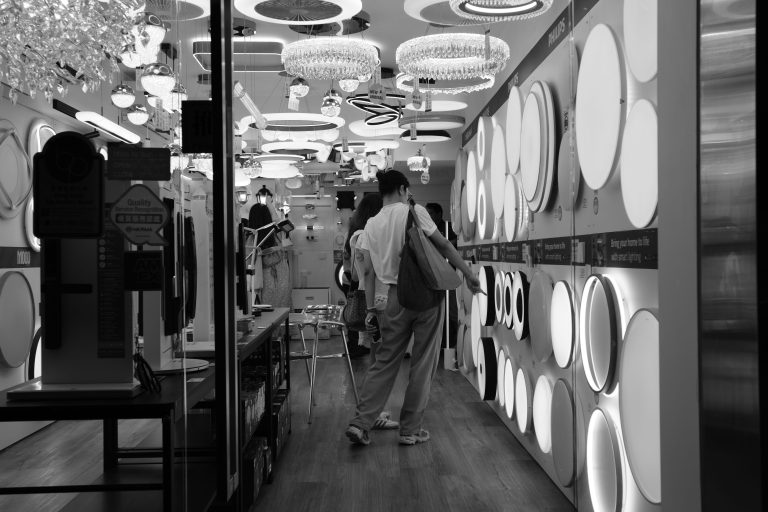
While technical lighting becomes more refined, decorative lighting is embracing a bolder approach. Sculptural and oversized luminaires are emerging as architectural focal points, rather than mere accessories. Oversized pendants, clustered installations, and distinctive floor and ceiling pieces are expected to define hospitality, retail, workplace, and premium residential interiors in 2027.
Successful statement lighting must still provide usable illumination and appropriate proportions. Modularity is expected to play a significant role, enabling designers to adapt the scale of installations to different spaces. The strongest lighting solutions for 2027 will combine design impact with practical value, featuring compatibility with smart controls, optical performance, modular components, and energy efficiency.
Suppliers capable of integrating these diverse roles into project-ready product families will be well-positioned to meet buyer demands in 2027. The Hong Kong International Lighting Fair (Spring Edition), scheduled for April 20 to 23, 2027, will feature a dedicated Light Lab showcasing the future of smart lighting through interactive products and real-world applications.