

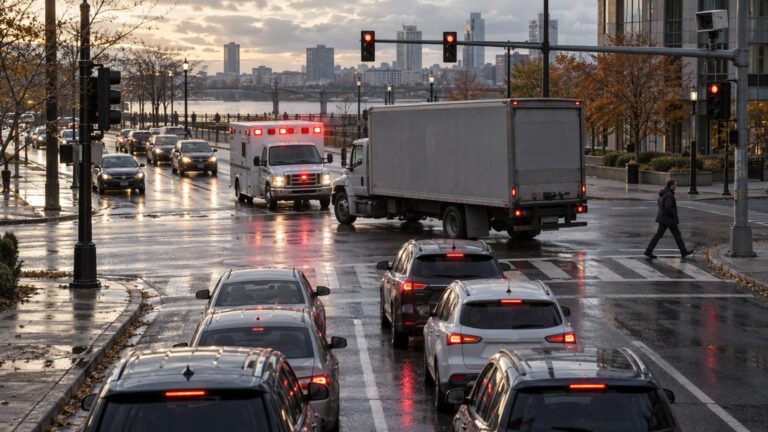
Every lane at the city intersection is full, so the ambulance driver must slow with lights flashing and siren sounding because a turning truck blocks the view. Before the ambulance reaches that queue, emergency vehicle preemption can change the sequence of traffic lights.
Emergency drivers still face risks when passing through intersections. At a signal, pedestrians may still be crossing while vehicles approach on a conflicting green. Preemption controls the traffic signal. Preemption doesn’t let the driver enter at unrestricted speed, so the driver must still check for a clear crossing before entering. Before the apparatus reaches the stop line, the intended signal sequence gives cross traffic a red light.
Why intersections turn response time into risk
Queues block the legal path
More road space doesn’t appear just because the siren is sounding. When every lane is occupied, drivers may have nowhere to pull over, and a red light keeps the vehicles ahead from advancing beyond the stop line. An open lane on a multilane road doesn’t rule out a vehicle hidden in the next lane. Drivers farther back can’t see the emergency vehicle’s path.

Conflicting movements create the greatest exposure
But an emergency driver entering against red still has to check that crossing traffic has yielded, including a driver screened by a bus or a building at the corner. Even after nearby motorists stop, pedestrians can still be in the crosswalk. You can’t tell if the next crossing lane is clear from that gap beside a stopped car. Don’t count dispatch processing or crew turnout in signal delay, since both happen before the vehicle encounters the intersection. For each intersection, measure the vehicle’s wait separately from its travel time between signals.
How emergency vehicle preemption changes the signal
Detection begins the request
To tell the relevant signal controller which approach needs green, the emergency vehicle preemption system sends it a request once it detects an authorized response vehicle. Optical vehicle emitters send signals that the intersection receivers pick up. Other designs send requests over cellular communications or connected vehicle messaging, with satellite positioning first locating the vehicle. To send requests, those designs use different equipment and communication paths. Satellite positioning alone doesn’t get the request sent. Whatever design you use, the system must distinguish a vehicle approaching the signal from one on a nearby street.
As city teams map each request path against current controllers and timing plans, they can review Miovision’s information about emergency vehicle preemption to assess signal-level options.
The controller clears conflicts in sequence
Green doesn’t come instantly. The controller transitions out of normal timing and generally completes required safety intervals before displaying green for the requested approach. Traffic already committed to the intersection gets time to clear while yellow and all-red clearance intervals run. What the signal does depends on its controller programming and local timing rules. In acceptance testing, check pedestrian timing for every transition the controller permits.
Normal timing resumes after passage
After the vehicle passes, the controller returns to normal operation, using its recovery settings to serve the approaches still waiting. Research by McHale and Collura at the Virginia Tech Transportation Institute in 2003 was summarized in the Federal Highway Administration’s (FHWA) August 2024 report. In FHWA’s account, preemption lasted an average of 25 seconds. Side-street effects cleared within one signal cycle in most cases. Side-street queues need checking during field evaluation as the signal recovers.
What cities need before changing existing signals
Hardware compatibility sets the practical boundary
For emergency vehicle preemption, choose hardware that matches the way you’ll send requests. You generally need an authorized vehicle-side identifier or communications unit and a means of carrying its request to the intersection. That request has to reach a controller configured for preemption through receiving equipment that’s compatible.
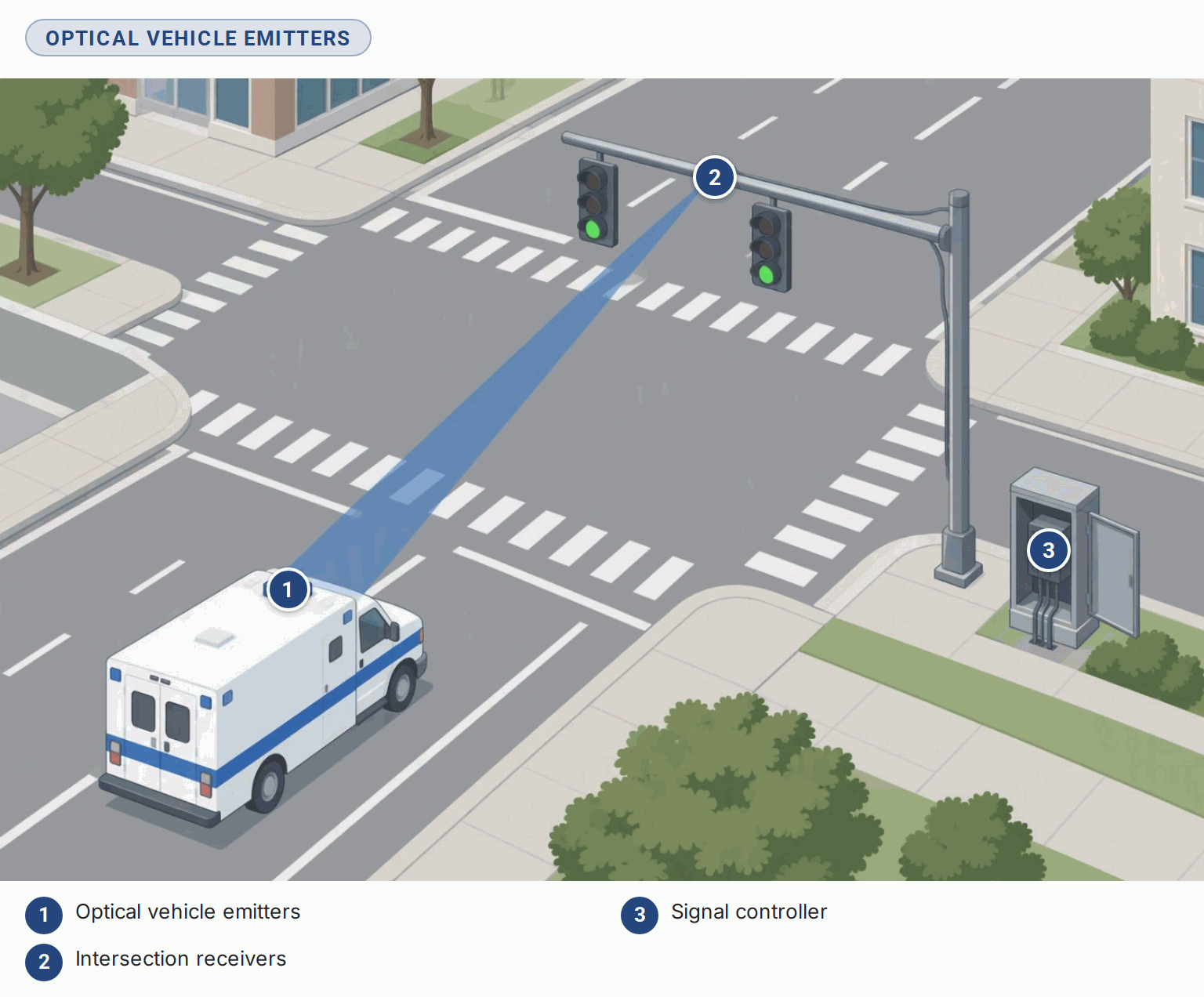
Before choosing a design, list every controller model and cabinet interface; keep a separate communications coverage record noting existing detection equipment and the owning agency. Some corridors may support phased installation using equipment already in place. At some sites, the cabinet or signal mast arm needs changes, so a new request method isn’t a fit for every legacy signal. Check your chosen fleet against that same inventory, then specify the vehicle units.
Operating policy matters as much as equipment
List the vehicles allowed to request preemption in your operating policy and specify when crews may activate it. Name someone to maintain the equipment. Address cybersecurity by agreeing on request-authentication requirements and spelling out how you’ll disable retired vehicle units so their credentials can’t be used to request signal changes. Transportation staff and public-safety agencies need a shared procedure for responding to equipment alarms.
First test simultaneous vehicle requests, including approaches on conflicting paths, before simulating lost communications to check the programmed fail-safe response. A green light isn’t the end of the test. After the vehicle clears, watch the signal’s recovery and enter the test results in acceptance logs. Put the owners of vehicle equipment and communications service on the signed responsibility matrix, then give intersection configuration and event data separate entries.
How to measure response time improvements from signal preemption
Before activation, take the measurements you’ll use to compare calls matched by route and congestion conditions within equivalent time periods and response categories. Staffing changes shouldn’t earn the signal controller credit, so keep travel time separate from dispatch processing and crew turnout time. Log any roadwork or route diversions during both measurement periods. Look in those records for trips that ran into unusual street conditions.
Use vehicle location records and intersection event logs to identify request receipt and the signal change, then determine when the vehicle cleared. Keep those clocks synchronized. The overall average isn’t enough; report median travel time and high-percentile times (including the 90th percentile).
Keep intersection waits separate from total route time in comparisons of equipped trips with similar unequipped trips or control corridors. Whenever a request fails, check the communications records. How much emergency driving took place matters when you review crash records; measure side-street recovery against the normal timing plan.
Published results show meaningful but variable effects
At each high-volume intersection in the U.S. Route 1 evaluation, preemption saved 30 to 45 seconds according to FHWA’s summary, with vehicles passing faster and encountering fewer conflicts.
Your own city can’t count on matching those time savings just because they were documented at the evaluated intersections. Judge the proposed corridor by your own matched trips and crash records.
Transit priority uses a different level of intervention
Priority and preemption solve different operating problems
Preemption interrupts or overrides normal signal timing for an active emergency request. Transit signal priority gives a bus smaller timing changes to help it stay on schedule, like a longer green or shorter red, not an exclusive emergency path. Conflicting traffic gets held when an emergency request instead triggers a formal signal transition.
A connected intersection can support both policies
A connected intersection can support both policies, but its controller needs explicit rules for competing requests.
| Control strategy | Primary purpose | Typical signal action | Operating condition |
|---|---|---|---|
| Emergency vehicle preemption | Clear an authorized emergency route | Transitions the requested approach to green while stopping conflicts | Active emergency response |
| Transit signal priority | Improve transit reliability | May extend green or shorten red within defined limits | Scheduled transit service |
Keep emergency travel logs out of transit schedule records, with separate authorization rules and performance measures set for each policy.
Intersections that respond before the vehicle arrives
With dependable communications and agencies sharing the work, connected signals can cut repeated emergency delays by running safe controller logic. To check whether your intersection waits are getting shorter, measure them openly. You can’t ignore pedestrians or cross traffic just to get emergency vehicles through. Get signals running normally again across the network. Before the emergency vehicle reaches the intersection, its authenticated request must reach the controller; start on a tested corridor with responsibilities written down and measurable results required.


