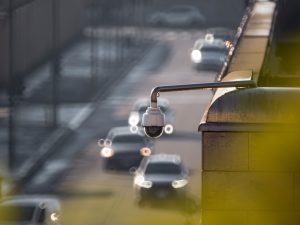
Police are pulling over drivers because AI flags their travel patterns as suspicious, and a Texas jury has found one stop unlawful. In Alek Schott’s case, a federal jury awarded $76 after finding that Bexar County deputies violated his Fourth Amendment rights through the stop, detention and search. The verdict concerned his case, not license plate surveillance as a whole.
Schott, an oilfield-equipment salesman, was driving from the Houston area toward the Texas border and back on a work trip. A law-enforcement messaging group flagged his route after automated license plate reader systems logged it. Deputies stopped him, citing a lane-line crossing. Trial evidence challenged that explanation, according to the source account of the case.
Why Police Stop Drivers Because AI Flags Their Routes
The jury awarded Schott one dollar for each minute he was detained. Its finding established Bexar County’s liability in this encounter. It did not rule that license plate surveillance technology is unconstitutional in every use.

License plate reader cameras record a vehicle’s location and the time it passes. Software can connect those sightings into a travel history, then flag routes or patterns for officers to investigate. The American Civil Liberties Union has reported that these systems have expanded beyond searching for specific wanted vehicles.
The records are incomplete by nature. Cameras do not cover every road, and equipment or data-sharing limits can leave gaps. A missing camera hit may reflect where a driver traveled, rather than an effort to conceal a trip. Treating the gap as suspicious can turn missing information into a reason for an encounter.
A separate account in the source describes a northern Virginia woman, Grace Knowles, who said an officer showed her a map of recorded vehicle sightings during a September 2025 road trip. She alleged that the officer questioned her account of visiting New Orleans because the system showed no corresponding hit there. The account has not been independently corroborated.
Travel Alerts Cannot Establish a Driver’s Intent
An Associated Press investigation reported that Border Patrol uses travel-pattern monitoring to flag vehicles and refer them to local police. The program considers origin, destination and route, with some resulting stops occurring hundreds of miles from the border.
At one point, Border Patrol reportedly had access to at least 1,600 cameras across 22 states through Flock Safety. The source also reports that the program used hidden cameras to build what it called a vehicle’s “pattern of life,” tracking how often it traveled and flagging movement the system calculated as abnormal. Customs and Border Protection told the AP that federal law, constitutional protections and agency policies govern its use of plate readers.
The source says the ACLU reported that Flock Safety promoted analysis linking vehicles repeatedly seen near one another. Such a connection does not itself show a criminal relationship. Family members, coworkers or neighbors may share locations without any wrongdoing.
These concerns sit alongside other uses of automated traffic technology. Cities’ automated traffic enforcement systems use cameras and software to detect violations, while edge AI infrastructure for smart cities processes camera data closer to where it is collected. Nairobi’s intelligent traffic system plans offer another example of data being used to manage urban roads. These projects have different stated aims, but all depend on how authorities collect and interpret traffic data.
Travel-pattern software can identify correlations, but an alert alone cannot establish intent or criminal conduct. The Schott verdict shows that a traffic explanation does not automatically settle whether the intelligence behind a stop was lawful. For drivers, the central question is how a system’s incomplete records and automated suspicions are weighed before an officer acts.